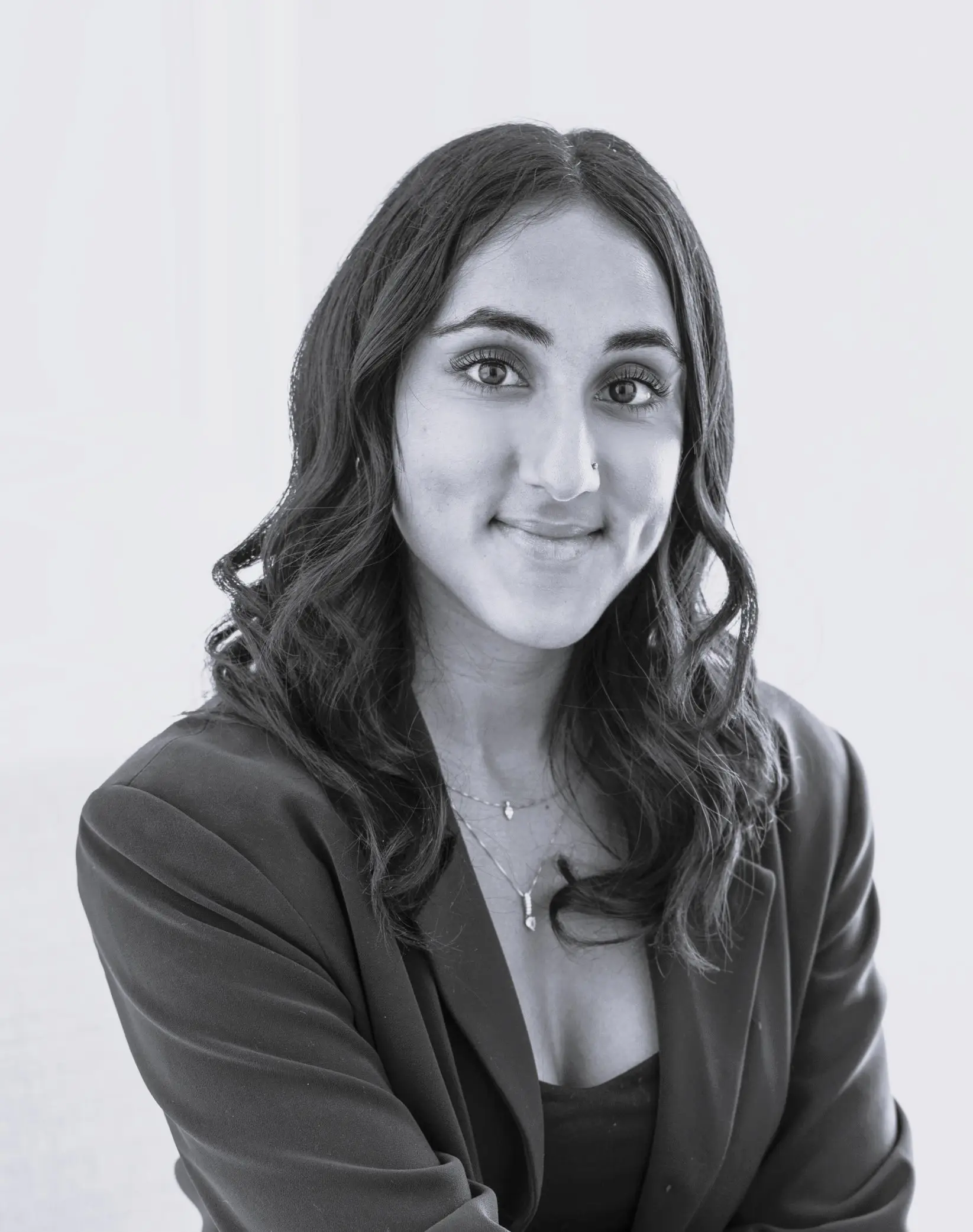
Employee Spotlight - Sahar Jessa
“One piece of advice I always come back to is to be a duck”
Sahar Jessa — April 30, 2026
What first drew you to consulting?
I didn’t come into consulting with a clear plan. If anything, I got there by figuring out what I didn’t want to do.
I studied both kinesiology and business during my undergrad, but I pretty quickly realized the traditional paths tied to kinesiology just weren’t for me. From there I shifted fully into business, where I explored marketing then worked in sports, which I really enjoyed, but each experience made me realize there was still something I was missing.
I didn’t want to be boxed into one function or one industry too early, which is initially what made consulting stand out. It felt like the first path that actually rewarded curiosity instead of forcing early specialization. The idea of working across different industries, different teams, and different types of problems really resonated with me.
At that stage, I wasn’t looking for a perfect answer of what my career would be for the next 10 years of my life. I was looking for breadth, exposure, and the ability to keep learning, and consulting offered all of that.
What has kept you excited at Level5?
It’s a simple answer – the variety. Even to this day, I still don’t know if I want to specialize or what I would want to focus on long term, so the fact that every client, every team, and every problem is different keeps things really interesting. Each project has its own personality, its own challenges, its own pace, and its own things to learn from.
There’s also something about the role that keeps you on your toes. No two days feel the same, and while that can be challenging at times, it also means you are constantly engaged. Throughout each project, you’re forced out of your comfort zone, and you don’t ever get the option to take a back seat.
This could be daring for some people, but for me it’s a positive because it keeps my gears turning and pushes me to keep learning.
Can you share a moment when you started to feel confident in your role?
For me, confidence has always been a bit of a fluid concept. Maybe that’s because I’ve always generally been a confident person, but what I’ve learned is that the confidence you feel at work is not just about you. It is also about your environment and the people around you. The moment I started to feel truly confident was when I felt the support of my teams here, and that happened within my first month at L5.
When you’re in an environment where people trust you, build you up, and create space for you to contribute, it definitely changes how you show up. It stopped feeling like I was doing things on my own and started feeling like I had the weight of a team behind me, which made a huge difference in how confident I felt day to day. I found myself more willing to share ideas, challenge thinking, ask questions, and take ownership in conversations with clients.
What have you learned about building strong relationships with colleagues and clients, and how does that impact the work you do?
There’s no shortcut to building strong relationships, but in my experience something that does help facilitate it is being yourself.
When I first started working, I thought I had to find my own version of a “work persona”. I tried to be more polished or more “professional” and held parts of my personality back, but over time, I realized people can sense that immediately.
The strongest relationships I’ve built, both with colleagues and clients, have come from being curious, and genuinely caring about the people I work with. I find that that carries through into the work and it changes your approach. Suddenly, you’re not just doing work for a company, you’re doing it for a person you’ve built a connection with, and it makes you want to do even better work for them.
I’ve seen this also shift projects entirely because when there is openness, it results in a client feeling more comfortable being candid, and then we can collectively move into solving the problem together. At the same time, you do have to meet people where they are. Not everyone is going to open up in the same way, and you have to read that and adjust. But when that connection is there, it makes a big difference in both the relationship and the outcome.
Who has had the biggest influence on your career so far, and how have they shaped you?
I always go straight to my parents when I think about this. They haven’t necessarily shaped exactly what I want to do, but they’ve shaped how I think about work and life in a big way. Coming from an immigrant family, there’s a strong sense of responsibility, working hard, and building something not just for yourself, but for the people around you and the generations to come.
Both of my parents really embody that. My mom built her career from the ground up as an owner of her own dental practice, and my dad has always been focused on helping others through his work as a doctor. A high level of grit and determination has been instilled in me from a young age.
Something else I’m grateful for is that they’ve given me a lot of perspective. Anytime I get caught up in something day to day, they’re the ones who remind me to think about the bigger picture, what I’m actually grateful for, and what really matters over the course of a week or a month, not just a single moment. This mindset has taught me to keep a level head, which has shaped how I approach my career and how I think about success more broadly.
What is one habit that has helped you grow or set you up for success?
The biggest one for me is staying in a student mindset, approaching every situation with the assumption that there’s something to learn. That means not going into a room thinking you have all the answers, but instead being open to listening, asking questions, and letting yourself be coached.
In consulting especially, you’re constantly working in new industries and with new clients. You’re not expected to know everything, but you’re expected to learn quickly. A lot of the value comes from being able to absorb information, understand different perspectives, and then build from there.
That mindset also shows up in how I seek out feedback and mentorship. Putting yourself in a position where you’re learning from others, whether from your team or your clients, makes a big difference in how quickly you grow.
I think it’s easy to feel like you need to prove yourself early on, but I’ve found that being open to learning and not trying to be the smartest person in the room takes you much further.
What advice would you give to someone early in their consulting career?
One piece of advice I always come back to is to be a duck.
It sounds simple, but the idea is that you let things roll off your back. In consulting, you’re going to deal with a lot of feedback, pressure, things not going the way you expected, or moments where you don’t have the right answer, but that’s all part of it.
When you’re a “duck,” beneath the water your feet are moving – you’re figuring things out and working through it, but on the surface, that effort doesn’t show. You stay calm and steady, continuing to move forward even when things underneath feel a bit chaotic
Regardless of how a situation may feel in the moment, you still have to show up with resilience. You can’t take everything personally, and you can’t let every challenge throw you off. Being able to take feedback, admit when you don’t know something, and keep going is what helps you grow.
I think early in your career, there’s a tendency to feel like you need to get everything right or prove yourself all the time. But what actually makes a difference is how you respond. Being resilient, staying open, and letting things roll off your back will take you a lot further.

SEND US A MESSAGE

© 2023 Level5 Strategy.
All Rights Reserved.
SIGN UP TO RECEIVE UPDATES