
The Hallway Test: Does Your Organization Understand its Priorities?
In practice, strategies are more likely to fade from memory than fail on their own merit.
Most organizations invest significant effort defining their priorities. Yet over time, when people are asked what really matters most, the answers start to vary. That is the problem the Hallway Test is designed to reveal.
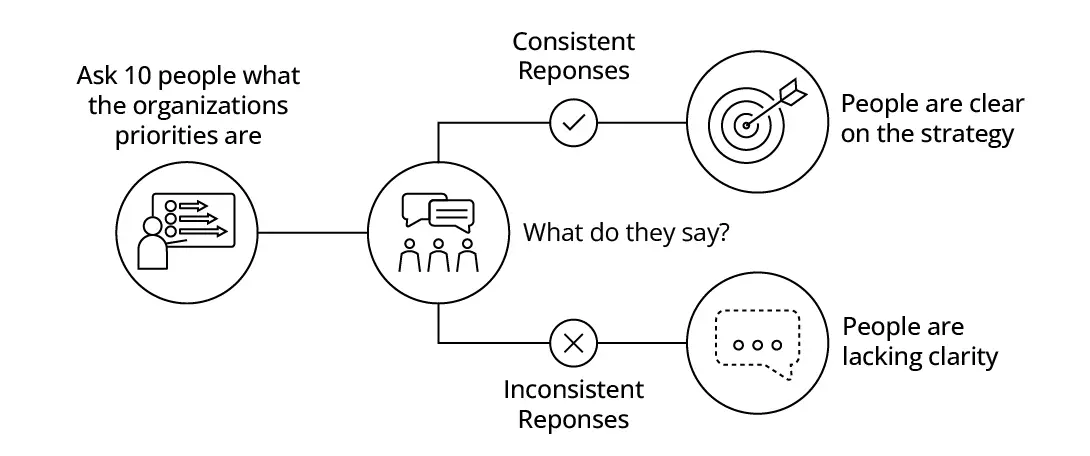 Stop ten people in the hallway and ask what the organization’s priorities are. If you do not hear the same few answers consistently, there is likely a clarity problem. The issue is usually not capability or commitment. More often, the strategy has not fully landed across the organization.
The organizations that pass the Hallway Test do three things well: they make the strategy simple, they build it into the environment around people, and they reinforce it consistently. The following article outlines how leading organizations use these tactics to ensure they pass the Hallway Test, and their strategy sticks.
Strategy Must be Simple Enough to be Remembered
Can people easily explain what matters most in their own words?
The Hallway Test asks whether a strategy is clear enough to live in people’s heads, not just in documents. Passing doesn’t mean everyone knows every initiative or metric. It means people understand what matters most and can describe it accurately, using language they remember and can easily repeat.
This is where many organizations struggle. Strategies often become long, dense documents designed to capture every detail. They may be comprehensive, but they are difficult to hold onto. People do not remember paragraphs. They remember a small number of clear ideas.
If employees cannot name the priorities without checking a document, there are probably too many priorities, or they are being expressed in a way that is too complex. Simplicity is not about reducing rigour. It is about making sure the strategy can live in people’s heads, not just on paper.
Publishing Collateral That Carries the Message
Is the strategy visible across the organization?
Publishing a strategy in a PDF, slide deck, or town hall is only the starting point. Awareness does not automatically create shared understanding.
To make priorities stick, organizations need to deliberately reflect them across the physical and virtual workplace. That can include office visuals, templates, screensavers, onboarding materials, internal communications, and other branded touchpoints that people see regularly. These are practical ways to keep the strategy visible and familiar.
The goal is not to repeat slogans for the sake of repetition. It is to create a consistent environment where employees encounter the same priorities often enough that the language becomes recognizable and easy to recall.
Strategy Only Sticks Through Consistent, Top‑Down Reinforcement
Is the message reinforced through everyday leadership behavior?
Even a clear strategy will fade if it’s treated as a one‑time launch. Over time, people join, people leave, and priorities compete for attention.
That is why leadership reinforcement matters. Strategies are more likely to stick when leaders use the same language in meetings, connect decisions back to stated priorities, reference them in performance discussions, and consistently link day-to-day work to strategic intent. This is what turns a strategy from a document into shared direction. When leaders reinforce the same priorities over time, employees are far more likely to understand what matters and will be empowered to act accordingly.
Conclusion
Strategies that endure are easy to remember, highly visible, and consistently reinforced. The hallway test isn’t inherently complicated to succeed at. It doesn’t require new dashboards or frameworks. It simply asks whether people can name what matters most without prompting. If people across the organization cannot clearly name the priorities, the strategy is unlikely to deliver its full value, no matter how strong it looks on paper.
At Level5 Strategy, an award-winning boutique management consulting firm based in Toronto, we help leading Canadian organizations navigate challenges in strategy communication with the right tools and insights. Whether you’re exploring our approach to strategy execution or looking to make priorities visible across your organization, our experienced team delivers the hands-on support needed to drive lasting success. For more expert perspectives on strategy communication, explore our latest thinking or connect with our team.


SEND US A MESSAGE

© 2023 Level5 Strategy.
All Rights Reserved.
SIGN UP TO RECEIVE UPDATES