
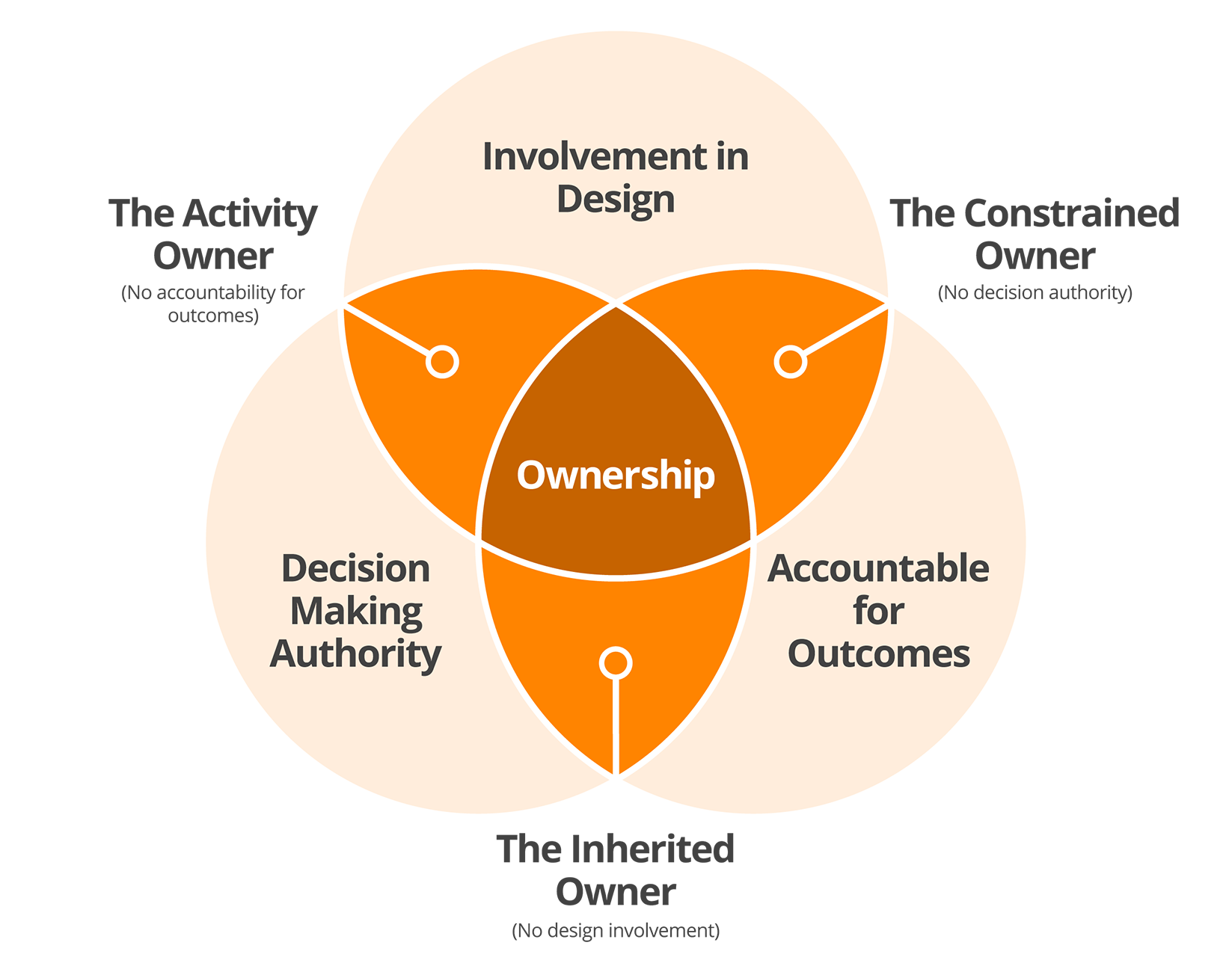
While alignment or effort may be working in the team’s favour, the missing ingredient is ownership of the strategy that is designed deliberately enough to survive real-world execution. Over years of helping organizations design and execute strategy, Level5 has seen the pattern above many times. What we’ve learned is that execution works best when ownership is supported by three conditions simultaneously.
- Involvement in Design
- Decision-Making Authority
- Accountability for Outcomes
Involvement in Design
Ownership starts before execution of the strategy ever begins. When the ultimate owner is involved in the design, they help shape the plan, challenge assumptions, and navigate the tradeoffs that define the work. Early involvement creates clarity about what needs to happen and why, and just as importantly, builds conviction in the direction chosen. The result is stronger commitment, fewer downstream resets, and execution that stays anchored to strategic intent.
Without involvement in design, you’ve assigned an inherited owner. You may be compliant but not committed, left accountable to execute a strategy they didn’t help create, didn’t test and may not believe in.
Real Decision-Making Authority
Ownership without authority is an illusion. When owners are trusted with real decision-making power, they can make timely tradeoffs, adapt as conditions change, and resolve issues where the work happens. This reduces escalation, limits second-guessing, and strengthens accountability.
Without decision-making authority, you’ve assigned a constrained owner. They may be accountable but not empowered, held to outcomes they can’t influence and forced to route decisions upwards and sideways.
Accountability for Outcomes
Ownership should be measured by outcomes, not activity. Clear outcome accountability keeps execution focused on impact rather than effort. When objectives are explicit and measurable, decisions and tradeoffs are made against the delivery of strategic outcomes, rather than simply advancing the plan.
Without accountability for outcomes, you’ve assigned an activity owner. They may be busy but aimless, rewarded for the number of boxes checked, not for the outcomes and results achieved.
How to Assign Ownership in Cross-Functional Initiatives & Projects
The same three ownership conditions still apply, even when work spans multiple functions. Here are some watchouts to consider:
- Avoid shared accountability. When more than one person is “accountable” ownership gets diluted. One owner must ultimately carry the responsibility for results.
- Anchor ownership to outcomes, not org charts. When ownership feels unclear, default to the role that owns the SMART objective is explicitly incentivized to deliver it. Then ensure that role is given real decision authority and outcome accountability.
- Make decision rights explicit. A clear RACI across functions removes ambiguity about who decides, who contributes and when escalation is required.
- Use governance to decide, not just to inform. Cross-functional work requires governance, but its purpose should be to make decisions, resolve conflicts and manage outcomes.
The Bottom Line
Ownership is about creating the conditions for people to do their best work. When involvement in design, decision-making authority, and accountability for outcomes are intentionally aligned, execution becomes clearer, faster, and more resilient. At Level5, we design ownership this way because strategy only sticks when the people responsible for executing are set up to succeed.
At Level5 Strategy, an award-winning boutique management consulting firm trusted by leading organizations, we help businesses navigate challenges in strategy execution with the right tools and insights. Whether you’re exploring our unique approach to strategic alignment or looking to learn more about strategy execution frameworks, our experienced team delivers the solutions and hands-on support needed to drive lasting success. For more expert perspectives on strategy execution, explore our latest thinking or connect with our team.


SEND US A MESSAGE

© 2023 Level5 Strategy.
All Rights Reserved.
SIGN UP TO RECEIVE UPDATES