
While each opportunity may have merit, organizations that attempt to pursue too many priorities at once often create complexity that slows decision-making and fragments execution internally, while making it harder for customers and stakeholders to understand what truly differentiates them externally.
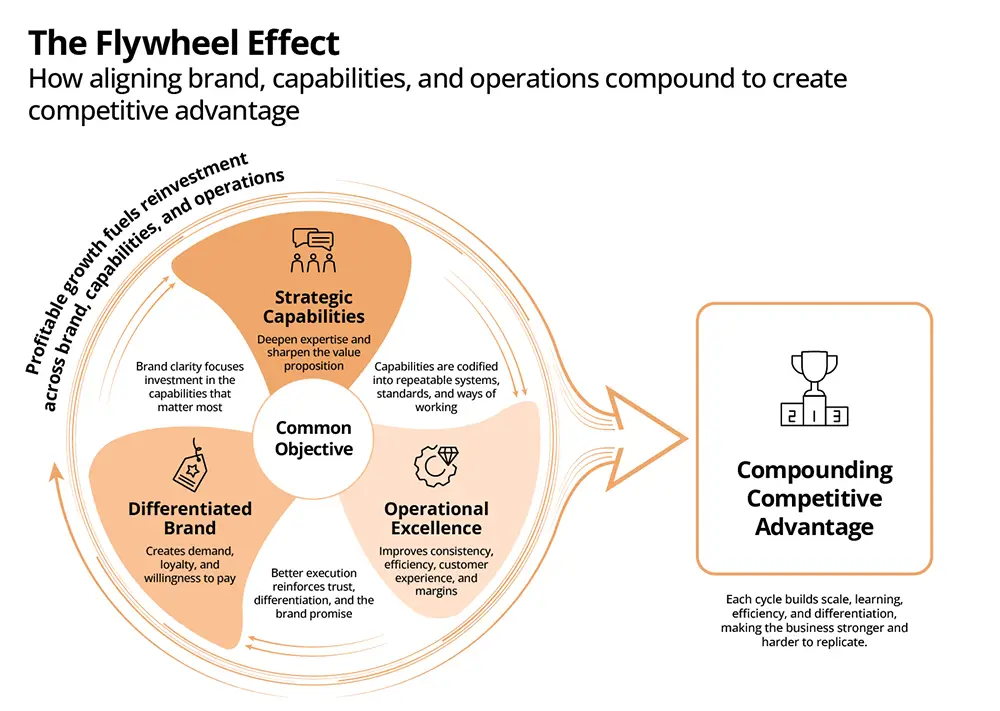
On the other hand, when organizations are disciplined about who they serve and which opportunities they pursue, they can create the conditions for a flywheel effect. The flywheel effect occurs when strategic trade-offs align a company’s brand, operations, and capabilities around a common objective. As these choices reinforce one another, they increase momentum, improve execution, strengthen differentiation, and create a virtuous cycle that compounds competitive advantage over time.
What Does a Strategic Trade-Off Really Mean?
A strategic trade-off is the deliberate decision to prioritize certain opportunities, customers, capabilities, or investments over others in order to focus resources and create a sustainable competitive advantage. The essence of strategy lies in these choices. What an organization chooses not to do is often as important as what it chooses to do.
Strategic trade-offs force leaders to answer critical questions:
- Which customer segments will we pursue, and which will we not?
- How will we win in the market through our value proposition and competitive positioning?
- Which capabilities and investments are most critical to creating long-term value?
- Where should we concentrate our people, capital, and leadership attention?
Trade-offs in action: Challenger banks
Many Canadian challenger banks have built differentiated strategies around a clear set of reinforcing trade-offs. By operating through a digital-first model, focusing on core banking products, and building a brand around value and transparency, they are able to offer customers a compelling proposition: higher rates, lower fees, and a simpler banking experience. The flywheel effect comes from the coherence of these choices. Lower complexity supports better customer economics, which strengthens the brand promise, attracts customers, and reinforces the operating model over time.
Challenger banks choose to…
- Operate through a digital-first model
- Offer higher rates and lower fees
- Focus on core banking products
- Simplify the customer experience and emphasize self-serve banking
So they choose not to…
- Build a large branch network
- Compete through complex bundles or premium tiers
- Maintain a broad shelf of products and financial services
- Design for high-touch, customized services
Why Is Deciding What Not to Do So Hard?
Trade-offs are difficult because they force organizations to make choices under uncertainty. While most leaders recognize the need for focus, the act of saying no can feel uncomfortable, risky, and politically complex.
Complexity creates more choices than ever.
Organizations are navigating rising customer expectations, rapid technological change, evolving social expectations, regulatory uncertainty, and shifting competitive dynamics. With more information to process and more opportunities to consider, focus becomes harder to maintain.
Every opportunity has a champion.
Most organizations are not short on good ideas. Each market, initiative, investment, or customer segment often has a compelling business case and an internal advocate. This makes trade-offs as much about alignment and leadership discipline as they are about analysis.
The stakes are high.
Strategic choices carry real implications for customers, employees, investments, and future growth. The fear of making the wrong decision can lead to over-analysis, delayed action, or an unwillingness to let go of lower-priority work.
Organizations struggle with strategic FOMO.
Saying no can feel like closing the door on future potential. As a result, leaders often preserve too many options, hoping to avoid missing the next big opportunity. But too much optionality can dilute focus, slow execution, and weaken impact.
How Can Leaders Make Better Trade-Offs?
Making better trade-offs requires more than prioritization. It requires a strategic filter that helps leaders decide where to focus, where to invest, and what to leave behind. Organizations that make trade-offs well are clear on who they serve, what they promise, and how the business must operate to deliver. They also distill the strategy into a few simple choices that people across the organization can understand and apply.
Start with a deep understanding of the customer or stakeholder.
Strong trade-offs begin with clarity on who the organization is trying to serve, and who it is not. This requires insight into the rational and emotional drivers of behaviour: what people need, value, believe, and trust. These insights help shape a brand strategy that is differentiated, ownable, and resonant.
Use brand strategy as an organizing principle.
Brand should be treated as a strategic decision-making framework, not just a marketing and communications asset. When leaders know what the brand stands for and how it creates value, they can better assess which opportunities reinforce the strategy and which dilute it. At its best, brand aligns choices across operations, capabilities, customer experience, culture, and investment.
Align capabilities and operations to the promise.
Trade-offs only create value when they shape how the organization works. Leaders should identify the capabilities most critical to delivering the Brand Promise, then align operating models, processes, talent, technology, and investment behind them. This creates the flywheel effect, where each aligned choice reinforces the next and builds competitive advantage over time.
Make opportunity cost explicit.
Most opportunities can look attractive in isolation. Strong trade-off decisions require leaders to ask what each choice will displace in terms of capital, talent, leadership attention, and execution capacity. Every “yes” should come with a clear understanding of what the organization is choosing not to pursue.
Communicate the strategy simply and consistently.
Trade-offs are more likely to stick when the strategy is easy to understand. Too often, organizations fail to communicate strategy simply and clearly, making it harder for teams to understand and internalize it. A simple, memorable, and well-understood strategy becomes a pre-filter for future ideas, opportunities, and investments, helping teams avoid distractions before they take root.