
Organizations can struggle with what to ask, which customers to hear from and which method will give them the evidence they need. A survey can show whether a pattern is widespread. A conversation can uncover why it exists. Behavioural and operational data can reveal whether what customers say matches what they do.
The challenge is not necessarily getting more customer input. It is getting the right insight for the decision at hand, understanding what the evidence can and cannot tell you, and knowing when you have enough to act.
Several common pitfalls can get in the way.
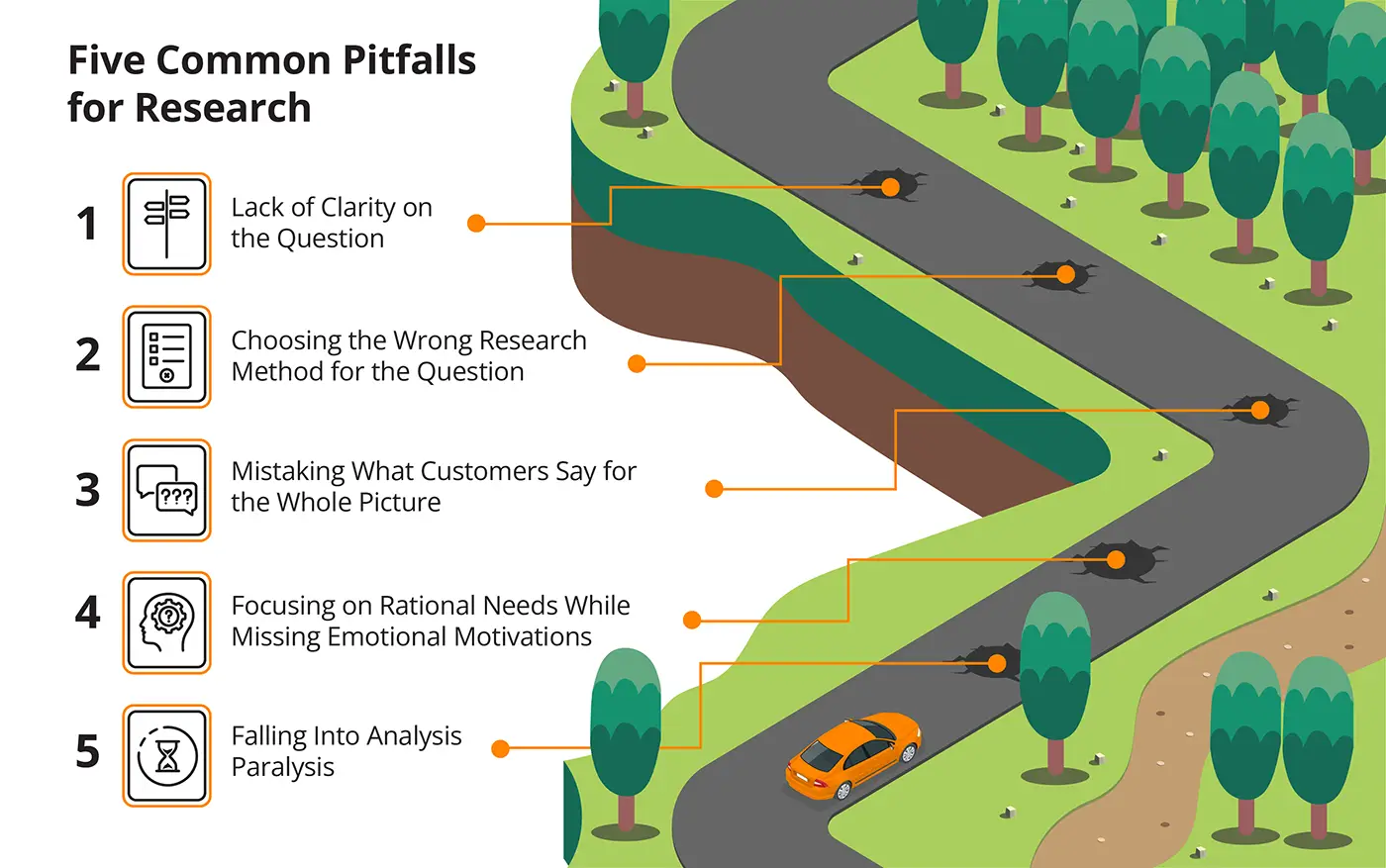
1. Lack of Clarity on the Question
Organizations often recognize that they need customer insight without being clear on the question they are trying to answer.
Before deciding to run a survey, host a focus group or analyze existing data, start with the business decision. Three questions can help:
- What do we need to understand?
- What business decision will this insight inform?
- What would we do differently depending on the answer?
The right level of research also depends on where the organization is in answering the question. Early on, the need may be broad: understand what is driving a behaviour or uncover an unmet need. Later, the organization may need to get much more specific, such as testing a particular concept or validating a proposed solution.
Problems arise when those stages get confused. Research can become too broad when a specific decision needs to be made, or too narrow before the organization understands the bigger issue.
Trying to make one study answer several different business questions creates another problem. Surveys and discussion guides become too long, participant energy wanes and the findings become less reliable. Going deeper on the issue that matters most usually produces more useful insight and a clearer path forward.
2. Choosing the Wrong Research Method for the Question
Organizations can undermine good research by choosing a method before considering what they actually need to learn. Different methods answer different types of questions.
Qualitative research can explore an issue, surface hypotheses and help explain why customers think or behave as they do. Quantitative research can test whether those patterns hold across a larger population. Existing behavioural, transactional or operational data provides another view of what is happening in practice.
Where resources allow, those methods can be combined. An organization might begin with qualitative research, use quantitative research to test emerging hypotheses at scale, then return to qualitative research to understand why the patterns exist and test possible responses.
There is no prescribed sequence. The pitfall is treating one method as the default rather than choosing the approach that best fits the question.
3. Mistaking What Customers Say for the Whole Picture
What customers say matters, but stated preference is not the same as lived behaviour.
Someone may say a greener or purpose-led product is important, for example, but still choose the least expensive option when finances are tight. Historical data may show how customers have behaved in the past, but it is backward-looking and may not reveal an emerging need or preference.
Stronger insight comes from looking across different signals: what customers say, what they do and what past behaviour shows. Differences between those signals are not necessarily a flaw in the research. They can be some of the most useful findings.
Who participates also shapes the picture. Organizations naturally tend to hear from customers who are easiest to reach, while recruitment methods and incentives can attract people with particular priorities or experiences.
The result can be a technically sound study that still represents only part of the customer base. Good research requires being deliberate about whose perspective is included, whose may be missing and how much confidence to place in what the findings represent.
4. Focusing on Rational Needs While Missing Emotional Motivations
Customer decisions are not made on rational considerations alone.
Research may ask whether someone wants a particular product, feature or service and produce a clear answer without uncovering what is actually driving it. Customers may be responding to uncertainty, pressure, convenience, risk, habit or emotion. The same person may make a different choice depending on the situation they are in.
That distinction matters because understanding the emotional need can lead to a very different business response than simply delivering what a customer says they want.
Insurance spotlight: Understanding the customer’s state of mind
Take for example an automotive claims customer experience, where research found that customers calling their insurer after a car accident were overwhelmed, anxious and unable to absorb all of the information being given to them in the moment.
On a purely rational level, customers needed to know what they had to do next. But the research uncovered something deeper: during that first interaction, many customers primarily needed to feel reassured, supported and confident that someone was helping them through the situation.
At the time, the first call tried to cover detailed next steps while the customer was still in a heightened emotional state. Customers often struggled to retain what they had been told, creating confusion and additional follow-up calls simply to revisit the information.
The insurer redesigned the communication flow around the customer’s state of mind. The first call focused on whether the customer was okay, what they needed immediately and reassurance that support was available. A short communication followed within the first day with only the most immediate points. More detailed process information came later, again in writing, when the customer was better able to absorb it and revisit it.
The important insight was not that customers wanted less information. It was that their emotional state changed what they needed in a particular moment, and therefore when and how the same information should be delivered.
That lesson extends well beyond insurance claims. Customer choices and experiences are shaped by context and emotion as well as rational needs. Research becomes more valuable when it uncovers those underlying motivations and helps the organization respond to them.
5. Falling Into Analysis Paralysis
Research creates value when it sharpens a decision and gives leaders greater confidence to act. The risk is continuing to gather evidence after the critical questions have been answered, extending the process without materially improving the decision.
In strategic planning, customer insight can help leaders determine which customers to prioritize, where to invest, which capabilities or experiences matter most and where to focus limited resources. It can also provide stronger rationale for the trade-offs that strategy requires.
For more operational decisions, testing can be the next step. A pilot, concept test or A/B test can put an idea in front of customers, show how they respond in practice and help the organization refine its approach before scaling. This is especially useful where stated preferences may differ from actual behaviour.
The discipline is knowing when additional research will meaningfully improve the decision and when the organization already has enough insight to move forward.
At Level5, we are strong proponents of primary customer research because it brings the customer directly into strategic and operational decisions. We are also practical business builders focused on making research investments work as hard as possible. That means designing research around the decision at hand, using budgets efficiently and moving from insight to action.
Research is an important part of the science of strategy, but it is not a substitute for the art of leadership. Customer insight gives leaders evidence to work with; it informs the answer but cannot be expected to provide it. The best decisions come from leaders weighing these insights alongside business context, organizational realities and other strategic considerations.