
During Strategic Planning, initiatives are usually defined by what they intend to achieve. However, there is one question that typically receives far less attention:
What will the organization not take on through this initiative?
When the answer remains vague, individual assumptions take hold. One leader may see a related project as part of the initiative; another may see it as separate. Over time, the initiative absorbs work that was never explicitly agreed upon, leaving the owner responsible for a commitment that no longer reflects the intention of the original scope. In implementation, teams are stretching capacity or delaying other work, while leadership sees the initiative falling behind.
According to Level5 research, 80% of organizations struggle to accomplish their initiatives[1]. Many factors sit behind that number. Defining what each initiative will not take on improves the odds of delivery by aligning its scope with available capacity and resolving key trade-offs before implementation begins.
Setting Boundaries as a Critical Implementation Enabler
Strategy determines which priorities an organization will pursue; initiative boundaries translate those priorities into clear, executable commitments and a shared bias for holding leaders and teams accountable for delivery.
This requires clarity across three boundaries:
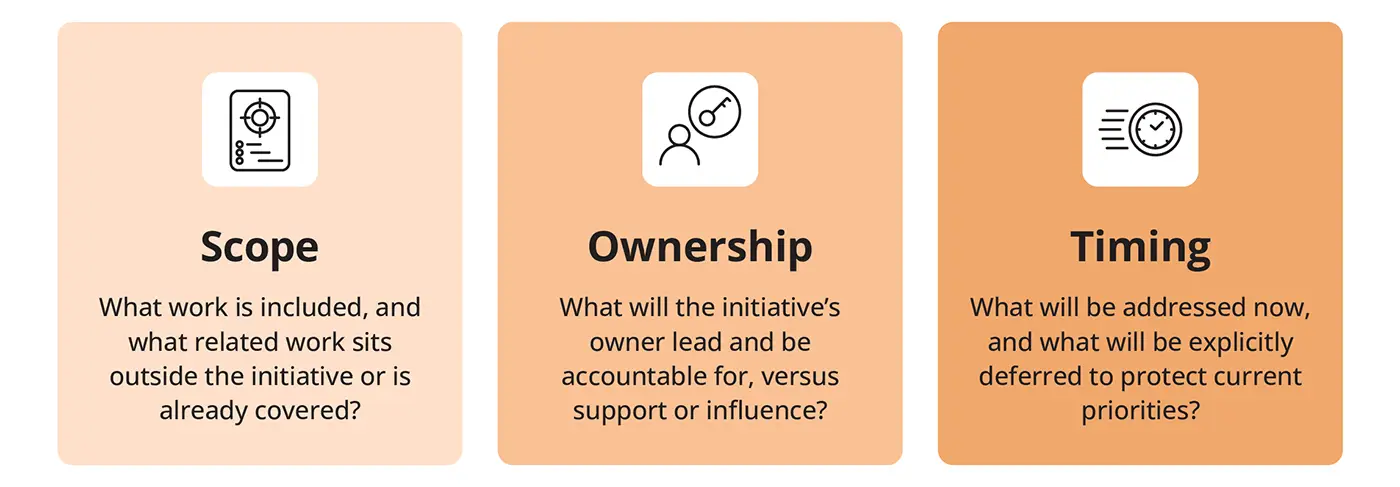
Boundary-setting should begin when the initiative is defined, action planning then tests that boundary against the practical realities of delivery. By the time implementation begins, teams should share the same understanding of what the initiative includes, what it excludes, and who is accountable for delivery.
That shared understanding is a critical implementation enabler. Without it, teams are left resolving strategic choices during implementation, slowing progress and stretching capacity. When an initiative begins to struggle, leaders should therefore look beyond delivery performance and revisit whether its scope, ownership and timing were clear from the outset.
Protecting Priorities Without Losing Good Ideas
Every organization runs into some version of this. There will always be another good idea competing for capacity, another stakeholder ask that seems reasonable to fold in, or another piece of important work sitting just outside an initiative’s edges. Deciding what an initiative will not include is a strategic decision about the commitment the organization is prepared to make within the current Strategic Plan.
Excluding something does not mean rejecting it. The work may belong under another initiative or be better suited to a future planning cycle. A documented “not now” list provides a practical way to manage those decisions by recording what was deferred, why and when it should be reconsidered. This keeps valuable ideas visible while protecting the priorities already included in the Strategic Plan.
Case Study: How One Ontario Regulator Defined Its Boundaries
Regulatory environments exacerbate the importance of defining initiative boundaries. In a recent Strategic Planning process with an Ontario regulator, several initiatives depended on governments, system partners or other regulators with authority of their own. The provincial regulator could not lead or own every outcome, creating a risk that the Strategic Plan would commit it to work beyond its mandate or control.
Clarifying Where to Lead, Support, and Influence
As teams defined how each initiative would be delivered, they also explicitly named the work the regulator would not take on in this strategic planning cycle. They considered whether the proposed scope aligned with the regulator’s mandate and available capacity, and whether the work was already covered elsewhere. This allowed them to distinguish the commitments the regulator would lead from those it would support or influence. For example, one initiative focused on improving alignment across jurisdictions. The regulator could contribute expertise and adapt its own processes, but it could not own national implementation or commit other jurisdictions to changes they controlled.
The Power of Clear Initiative Boundaries
These choices did not make the Strategic Plan less ambitious. They made its commitments more credible and achievable. Initiative owners understood what they were responsible for delivering, and the organization had a shared view of what sat outside each initiative.
For a regulator, this clarity carries added importance. Unclear boundaries can create expectations beyond its statutory authority and blur the distinction between what the regulator is accountable for and outcomes that depend on the wider system it operates within.
The Bottom Line: Clear Boundaries Make Ambition Achievable
Ambition does not become achievable because leaders document everything they hope to accomplish. It becomes achievable when leaders make an explicit commitment: this is the outcome, this is what we will own, and this is what must wait. Clear boundaries do not reduce ambition. They safeguard the focus and capacity required to deliver it.