
The idea of starting smaller
In many organizations, momentum slows because the strategy feels too large to translate into action. Teams can see the scale of what needs to change in new priorities, new behaviours, new ways of working, and new expectations. Faced with that complexity, the natural reaction is often to pause. People wait for more clarity, more capacity, or more certainty before they move, and naturally resort to routine ways of working.
The opposite can be just as challenging. Some organizations respond to a bold strategy by activating too much at once. Every initiative becomes urgent. Every priority competes for the same capacity. Early activity creates the feeling of momentum, but as roadblocks emerge and resources are stretched, energy turns into fatigue.
In one case, the organization struggles to start. In the other, it struggles to sustain. Both can lead to initiatives stalling out. Starting smaller with a “10% move” gives the organization a way to overcome the inertia. It lowers the barrier to action and gives the organization an initial goal that feels achievable, visible and connected to the overall ambition.
Building rhythm
Starting smaller helps organizations move, but rhythm is what keeps it moving. The first step creates energy, proving that progress is possible, but without rhythm, that progress can feel isolated. Strategy execution is often treated as a push. First align the team, then launch the work, drive the initiatives, and report on progress. But a strategy does not execute well because people act on it once, but rather when the organization repeats behaviours that support the execution. Imagine a person who sets a goal to go to the gym more often. At the start they go once every two weeks. They slowly start to see progress, so they increase it to once a week, and then a couple times a week, and before they know it, they have started to build a rhythm in which they are going to the gym consistently. The intensity of effort is not where the progress shows up, but rather the cadence in which the effort is performed. The same is true for organizations. A single initiative can create movement, but repeated action is what creates momentum.
Rhythm can look like launching the next set of initiatives once early ones have created traction. It can mean setting a higher bar in areas where the organization has already started to move. It can mean revisiting priorities more frequently, reallocating resources toward what is gaining momentum, or challenging teams to build on progress rather than simply report that progress has occurred.
Momentum is built 10% at a time, but the 10% has to repeat. Otherwise, progress remains a heroic moment instead of becoming a pattern.
Keep improving
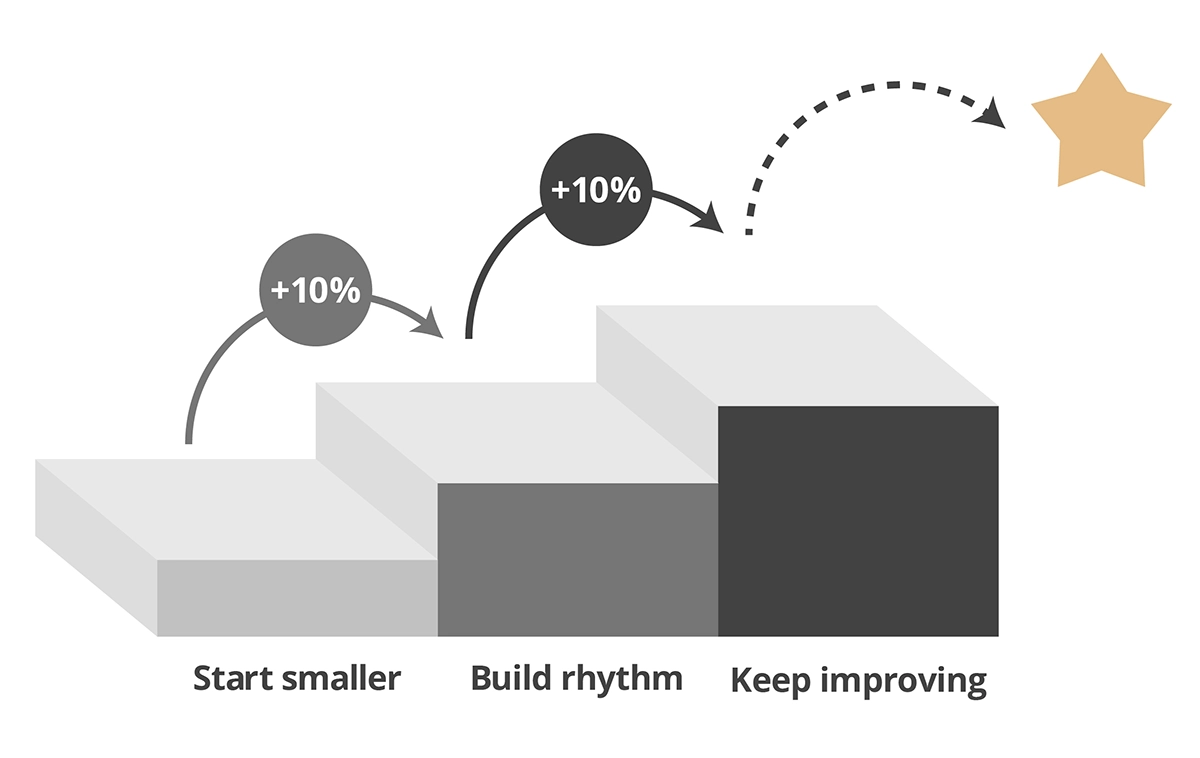
Building rhythm is essential in strategy execution, but rhythm alone is not the end goal. In fact, once an organization finds a rhythm, a new risk can emerge: comfort. The language of the strategy becomes familiar after executing for a long time. But familiarity can create a false sense of progress. Over time, a rhythm that once created movement, can become routine. The organization gets comfortable with the cadence, but stops pushing the strategy forward with the same intent to drive outcomes.
The power of “10% at a time” is not only that it helps an organization start. It is that it creates a habit of continuous refinement. Once one step has been taken, the next question becomes: what can be 10% better from here? This question matters because momentum can stall quietly. A team may hit its early targets and assume the hardest work is done. Without continued pressure to improve, organizations can drift back toward old habits.
For leaders, this is where sustained execution requires both encouragement and challenge. Teams need to see that progress is recognized, but they also need to know that progress raises the bar. Each improvement should create confidence, but also new expectations. Progress compounds through repeated improvements that build on each other over time, creating even stronger habits the following quarter.